How to Access a SolidWorks PDM Vault Online: 5 Methods

Five ways to reach your CAD files from outside the office — VPN, Web2, remote desktop, cloud hosting, file sync — what each one costs you, and where Sibe, cloud CAD document management for SolidWorks teams, fits.
Start with the job, not the tool
You need the same CAD files at home, at a supplier's plant, and on a laptop in a hotel that you have at your desk. Five routes get you there, and each one trades something — speed, functionality, cost, or IT time.
There is also a sixth answer, and it changes the question rather than answering it. Sibe is cloud CAD document management for SolidWorks teams: a native SolidWorks add-in, with your files living in the cloud from the first day. There is no office network to reach back into and no route to configure. Engineers check files in and out directly in SolidWorks, Sibe tracks every version as they go, and anyone without a CAD seat opens the model in a browser from a share link. That gets its own section at the end.
The five routes come first, on their own terms.
Why remote access needs a plan
SOLIDWORKS® PDM is Dassault Systèmes' on-premise data management product for SOLIDWORKS 3D CAD. Per Dassault Systèmes' published product documentation (accessed 31 August 2026), the vault is built around Windows file system integration: a local view folder on each workstation, an archive server holding the files, and a SQL database holding the metadata, all designed to run at LAN speed.
That design shapes what remote access looks like. Assemblies run to multiple gigabytes. Latency shows up as lag on every file operation, not just the big ones. And CAD IP is usually the most valuable thing a manufacturer owns, so nothing reaches the open internet without a security review.
Every method below does one of two things: it extends the office network out to the remote user, or it brings the remote user in.
The five routes at a glance
| Method | What it does | Best for | Trade-off |
|---|---|---|---|
| VPN | Puts your remote machine on the office network | One or two people off-site occasionally | Every check-out crosses the office upload link |
| Web2 | Browser access to file history, metadata, workflow state and approvals | Reviewers and managers without a CAD seat | Viewing and approving only; Professional licences only |
| Remote desktop or VDI | Drives a Windows machine that sits inside the office network | Full native performance on large assemblies | One machine per concurrent user; inherits office uptime |
| Cloud-hosted vault | Archive server, SQL database and clients provisioned in Azure or AWS | Engineering distributed across time zones | Monthly infrastructure cost, plus patching and backups |
| File sync or replication | Copies vault folders between sites so each office reads locally | Several permanent offices needing local read speed | Replicates files, not vault workflow; a multi-site project |
Each route is covered in full below. Cloud CAD document management is a different answer to the same question and gets its own section at the end.
1. VPN
How it works. A VPN client puts your remote machine on the office network. The vault then behaves the way it does at your desk, because as far as Windows is concerned, you are at your desk.
What you need. A VPN endpoint on the office firewall with a static IP or DDNS, the right ports open, and user permissions handled through Active Directory.
Where it stops. Every byte of a check-out crosses your office upload link. A 2 GB assembly on a 20 Mbit upstream takes roughly 13 minutes before anyone opens anything. Two engineers pulling at once takes twice that.
Fits when one or two people work off-site occasionally and the office has real upstream bandwidth.
2. Web2
How it works. Web2 is the browser interface that ships with SOLIDWORKS PDM Professional. Users sign in from a browser to see file history, metadata and workflow state, download files, and take part in approvals.
What you need. The Web2 server component installed and published over HTTPS behind the firewall, with Windows or PDM authentication in place.
Where it stops. Web2 covers viewing and approving. Check-in, check-out and administration stay in the desktop client (Dassault Systèmes product documentation, accessed 31 August 2026). It is also Professional only, so Standard licences do not have it.
Fits when the people outside the office are reviewers and managers, not engineers editing geometry.
3. Remote desktop or VDI
How it works. RDP, Citrix or a VDI broker connects you to a Windows machine that already sits inside the office network. Nothing about the vault changes; you are simply driving a keyboard from further away.
What you need. An always-on workstation or a virtual desktop per concurrent user, a GPU profile that can handle 3D, and a broker or gateway you are willing to expose.
Where it stops. Concurrency. Two people need two machines. Ten people need ten, plus the licensing that comes with them. Office power cuts and internet outages take everyone offline at once.
Fits when you need full native performance on large assemblies and the headcount is small.
4. Hosting the vault in the cloud
How it works. The archive server, SQL database and clients are provisioned in Azure or AWS instead of a server room, and everyone connects to that.
What you need. Infrastructure skills in-house or on retainer, tuned storage and compute, and a licensing review — running the product on hosted infrastructure has to comply with the terms you signed.
Where it stops. You now pay monthly for compute, storage, egress and SQL licensing, and someone has to own patching and backups. The vault is remote-first, but the administration did not go away.
Fits when engineering is genuinely distributed across time zones and you already run infrastructure in the cloud.
5. File sync and replication
How it works. Tools such as Panzura, Nasuni or DFS replication copy vault folders between sites so each office reads from something local.
What you need. A replication topology that matches your site layout, and a lot of care about which site is authoritative.
Where it stops. These tools replicate files. They do not understand vault workflow or the database behind it, and a replication design that fights the vault's own locking can leave the database and the archive out of step. Treat this as a multi-site infrastructure project, not a remote-access shortcut.
Fits when you have several permanent offices that each need local read speed.
How to choose
Four questions settle it faster than a feature list.
- Who is outside the office? Engineers editing geometry need a different route than reviewers signing off drawings
- How big is a typical check-out? Anything over a gigabyte makes upstream bandwidth the deciding factor
- Who owns the infrastructure? If nobody on the team wants to patch a server at 9pm, rule out the routes that require it
- What happens when the office goes dark? Routes that depend on an on-premise machine inherit its uptime
Security, whichever route you take
- Encrypt every connection — VPN tunnel or HTTPS, no exceptions
- Authenticate every user individually, and review permissions when people change roles
- Keep access logs and actually read them
- Never expose SQL or archive server ports straight to the internet
- Decide in advance what a departing contractor loses access to, and how fast
Where Sibe fits
Sibe is a collaboration-first CAD document management platform for SolidWorks teams. Your files live in the cloud from the first day, so there is no office network to extend and no route to choose — you sign in and your work is there.
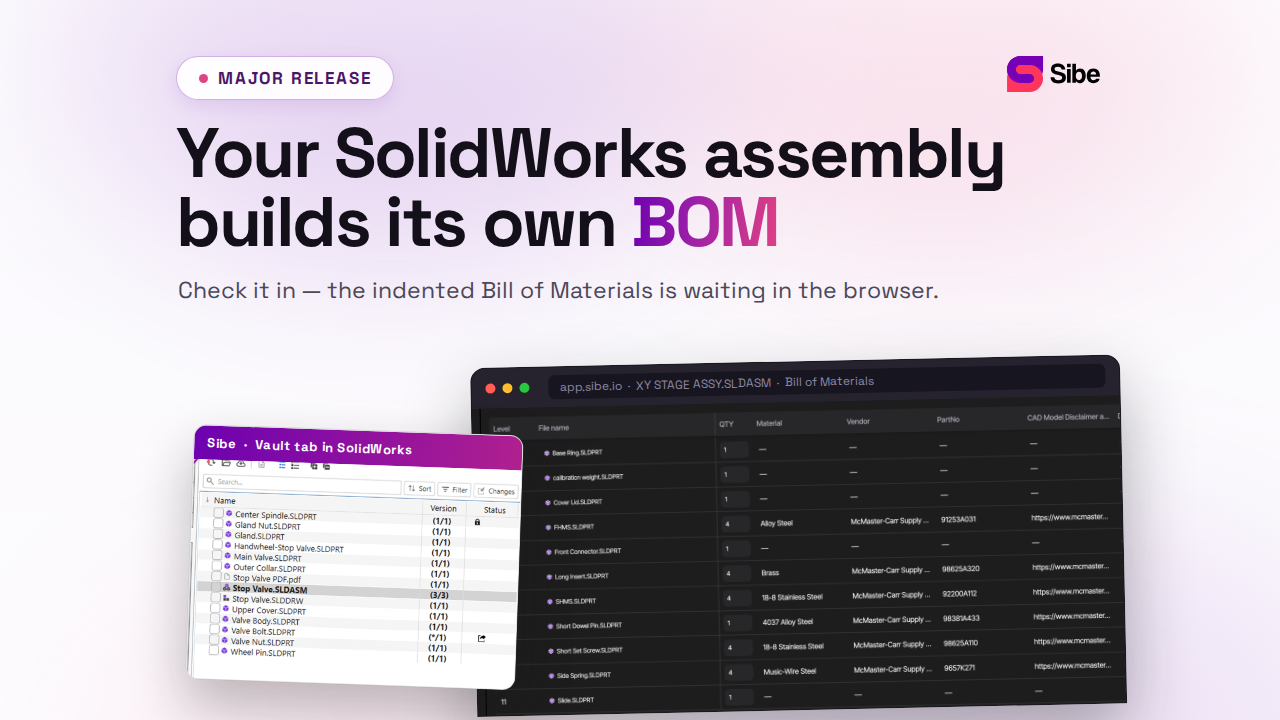
Engineers check files in and out directly in SolidWorks through a native add-in, and Sibe tracks every version as they go. A local cache folder mirrors your folder structure, so the layout on disk stays familiar. Assembly references resolve on their own, including for parts shared across projects.
People without a CAD seat get a free public share link or a QR code and open the model in any browser. No Sibe account, no viewer install, no emailed STEP file that goes stale the same afternoon.
Setup runs in under 20 minutes. No servers, no VPNs, no admin hassles.
If your team is deciding how to work outside the office, book a free 20-minute demo and we will walk through your setup, or try Sibe free for 14 days — no credit card.
Book a free Demo with Ken to see Sibe in action


Ken Maren
Chief Solutions Architect
SolidWorks Expert with 30+ Years Experience
Redirecting...
Demo bookings need a company email address. To use a personal one, choose Try Sibe for free below.
.png)